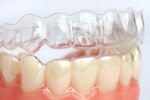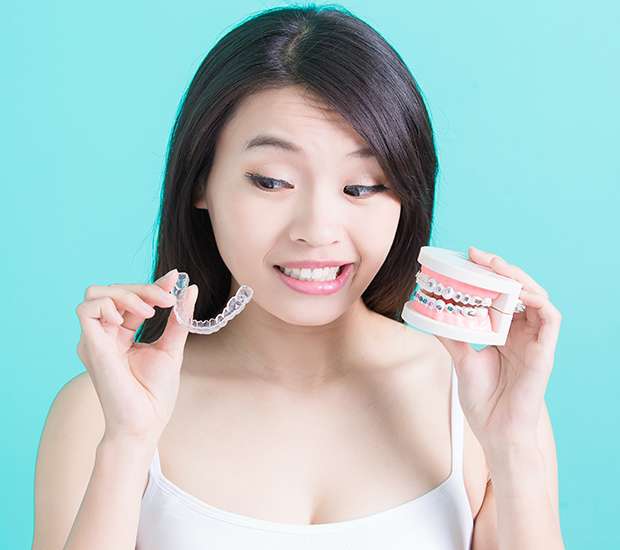
If you are looking into orthodontics options for your teen, it is important to consider Invisalign® vs. traditional braces for teens. You should also know what both solutions look like on a daily basis. Essentially, any orthodontic solution will move teeth by applying pressure. This pressure has to be placed on the right teeth at the right time so that gradually, they move into position. Both solutions do an excellent job. At the end of the day it really comes down to lifestyle, convenience, and what your teen will feel confident wearing.
Begin Straightening Your Smile Today
At Robert Martini, DDS, we welcome you to call (201) 262-3663 and schedule an appointment with our Emerson, NJ dental office. At the appointment, we can examine your teen and let you know if Invisalign® is right for them. During this appointment, we will answer any questions that you or they have so that they can be empowered to decide how to proceed. After all, while your teen is still a child, an orthodontics treatment requires their involvement and commitment. Once we have it, their treatment will go smoothly and their smile will be transformed into something beautiful.
Here are a few things that you should know about the lifestyle differences with Invisalign® vs. traditional braces for teens:
Costs –
At Robert Martini, DDS, we know that the cost of orthodontics is relatively the same, whether your teen gets braces or Invisalign®. We can give you a full breakdown and discuss payment options when you come in for a consultation.
Time –
If school attendance is important for your teen, than Invisalign Teen® is their best option. They will miss fewer days from school for dental appointments because we only need to see them once every four to six weeks. With traditional braces, some patients need to come in every two to four weeks.
Aesthetics –
When it comes to appearance, nothing beats Invisalign®. Keep this in mind when comparing Invisalign® vs. traditional braces for teens. The aligners are clear, so hardly anyone will notice that they are wearing them. The biggest aesthetic benefit is that as their teeth begin to move, their smile will look better. Being able to see an improvement quickly will help your teen to feel encouraged to keep up with the process, knowing that their smile will only get more and more attractive.
Eating –
In our Emerson dental office, one of the biggest concerns we hear from teens (especially the hungry ones) is that wearing orthodontics will impact their daily diet. We know that most of our younger patients are fairly particular in what they eat and at the very least, have multiple favorite foods. If things like pizza, hamburgers, sandwiches and popcorn are on their “must have” list, than Invisalign® is a far better option than braces. When wearing traditional metal braces, teens have to eat carefully. You cannot simply bite into a burger or sandwich and if you do, you will have a ton of food stuck in between your teeth. For teens, and adults, this can be completely embarrassing. Many teens change what they eat while wearing braces while others simply don’t eat in public. Both can be inconvenient and silly when Invisalign® provides a better way. Since the Invisalign® aligners are designed to come out while eating, your teen can eat whatever they want without worrying about how they look or their orthodontics becoming damaged. This means that life can continue on like normal, without the annoying adjustments that teens don’t enjoy.
Check out what others are saying about our Invisalign® services on Yelp: Invisalign vs Traditional Braces Emerson
Oral hygiene –
Another factor to compare when evaluating Invisalign® vs. traditional braces for teens is oral hygiene. This is a big deal because, as a dentist, we do not want any of our patients to suffer from decay and as a parent, you do not want your child to end up with a bunch of cavities. At Robert Martini, DDS, our solution is to provide teens with Invisalign® instead of braces. When wearing braces, the risk for decay naturally goes up because it is harder to keep teeth clean. With Invisalign®, the aligners come out while brushing so their oral hygiene routine can remain virtually the same. The only slight difference is that the aligners need to be brushed with warm water and a soft toothbrush before being put back in. We can also recommend a special cleaning solution but otherwise, the process is the same as always and completely easy. If your teen gets braces instead, they will need to use a special flossing tool and a brush that looks like a tree to get the food particles and plaque off of the area around the brackets. This has to be repeated for every tooth so you can imagine how much longer it will take.
School activities –
Don’t forget school activities when comparing Invisalign® vs. traditional braces for teens. At Robert Martini, DDS, we have found that the majority of our patients do more than simply go to school. They are in the band, choir, play sports, act in the school play, etc. In other words – they are busy. Braces can interfere with this because they can be uncomfortable and make it difficult to play an instrument. They can also create a hazard when playing high-impact sports. Fortunately, Invisalign® does not. The aligners can be removed during any of these activities so that your teen does not have to sacrifice anything to straighten their teeth. They will be far happier with the process as a result. If you are unsure about a specific activity and how Invisalign® could impact it, visit our Emerson, NJ dental office to speak with Dr. Martini.
After braces –
Once your teen is done wearing Invisalign or traditional braces they will need to wear a retainer. It is normal and few, if any, can escape this reality. The reason is simple. Teeth can revert back to their old position, if only slightly. Wearing a retainer at night, can help to keep teeth in the correct and improved position. The good news is that your teen will be so used to wearing their aligners, a retainer will not seem like a big deal. In our Emerson dental office, we can explain the various options for retainers but typically recommend a clear, full retainer that closely resembles the aligners they are accustomed to.
Call our Emerson, New Jersey dental office at (201) 262-3663 to discuss this solution in further detail. At Robert Martini, DDS, we can answer your questions and help your teen to make an informed decision regarding their orthodontics treatment. We are located in the Emerson area and look forward to meeting you to discuss Invisalign Teen®.
How do I get started with Invisalign®?
Call (201) 262-3663 and schedule a consultation with Robert Martini, DDS.
Questions Answered on This Page
Q. How long will Invisalign® treatment take?
Q. Will I be able to continue eating what I want to eat?
Q. What do I do with Invisalign® when I play a sport?
People Also Ask
Definition of Invisalign® Terminology
Aligner Trays
With Invisalign® treatment, the patient will receive a series of aligner trays and swap out each one for the next one in the series every two weeks in order to gradually straighten the teeth.
Blue Compliance Indicator (Invisalign® Teen)
The blue compliance indicator is a small blue dot on the aligners that will fade from blue to clear in order to indicate if the patient is wearing the aligner for the proper amount of time and where the patient is in the Invisalign® process.
ClinCheck® Software
ClinCheck® software allows professionals to map out the straightening process the patient’s teeth will go through with Invisalign® in great detail.
Blue Compliance Indicator (Invisalign® Teen)
The blue compliance indicator is a small blue dot on the aligners that will fade from blue to clear in order to indicate if the patient is wearing the aligner for the proper amount of time and where the patient is in the Invisalign® process.
Gum Line
The gum line is the line in the mouth where the teeth and gums meet. If a patient struggles with gum recession, then the gum tissue around the teeth may begin to wear away.
Incisal Ridges
Incisal ridges are the portion of the crown of the tooth that makes up the incisal portion and can be a direct cause of overbite if they are extended too far.
iTero Element® Scanner
An iTero Element® scanner allows professionals to create a 3D image of the patient’s teeth in minutes and predict what it will take to move the teeth into proper alignment.
Malocclusion
Malocclusion is the condition in which the upper and lower teeth do not meet properly when the bite is closed. Conditions of malocclusion can include overbite, underbite, crossbite and open bite; all of which are treatable with Invisalign®.
Overbite
An overbite is a type of malocclusion that occurs when the upper teeth jut out over the lower teeth, covering them and causing other issues.
Polyurethane Resin
Polyurethane Resin is a USP Class VI medical grade, high molecular weight compound that makes up the Invisalign® aligners.
SmartForce Attachments
SmartForce attachments are small attachments that professionals place on the patient’s teeth before placing aligners to help move the teeth.
Smart Track® Material
Smart Track® material is in Invisalign® aligners to increase comfort, improve control of movement, increases the speed of treatment and applies a gentle force to the teeth over time.
Smile-Scan
Smile-Scan analyzes the way a patient smiles by measuring the position of the mouth and eyes before giving a score.
Vivera® Retainers
Vivera® retainers are a type of retainer that consists of clear plastic material and helps to maintain orthodontic corrections after a treatment.